Toilet Cleaner Guide: How to Pick One That Actually Works
Most people don’t think about their toilet cleaner until the one they’re using stops working. The bowl still looks dull after scrubbing, the smell comes back within a day, or the “instant” stain remover needs three applications to touch a hard water ring that’s been building for months. After years of dealing with bathroom maintenance across different water types — hard, soft, borderline industrial in some Delhi colonies — I’ve learned that the label rarely tells you what you need to know. This guide does.
Why Most Toilet Cleaners Underperform
A toilet bowl isn’t a simple surface. It’s porcelain under the waterline, exposed to standing water 24/7, and it collects three very different kinds of grime: mineral scale from hard water, organic buildup from waste residue, and biofilm — the slimy layer bacteria build to protect themselves. A cleaner that handles one of these does nothing for the other two.
This is the single biggest reason people feel like they’re “cleaning” without the toilet ever looking clean. They’re using a fragrance-heavy general cleaner on a mineral scale problem, or an acid descaler on a biofilm problem. Wrong tool, right effort, no result.
Hard water rings need acid. Limescale and iron staining are alkaline mineral deposits, and only an acidic formula — hydrochloric, phosphoric, or a milder organic acid — breaks the bond between the mineral and the porcelain.
Yellow/brown organic staining near the waterline responds better to enzyme or surfactant-based cleaners that lift residue rather than dissolve it chemically.
Odor and bacteria are a disinfection problem, not a stain problem. A cleaner can leave a bowl visually spotless and still be doing nothing to the microbial load sitting just under the rim.
Here’s the part most product pages skip: no single formula does all three equally well. Every toilet cleaner on the market is a compromise between these three jobs, and understanding which one it leans toward tells you whether it’s right for your bathroom.
The Four Main Types of Toilet Cleaner (And When Each One Actually Wins)
| Type | Primary strength | Weak against | Best for |
|---|---|---|---|
| Acid-based liquid | Hard water scale, rust rings | Odor control, organic buildup | Hard water areas, visible mineral rings |
| Bleach-based liquid | Disinfection, whitening, odor kill | Rust stains, gentle on colored grout | Shared/public bathrooms, high-traffic homes |
| Enzyme/bio cleaner | Organic residue, drain-adjacent buildup | Mineral scale | Low-traffic bathrooms, eco-conscious households |
| Gel/thick-formula cleaner | Cling time on vertical surfaces, under-rim coverage | Runs off quickly if too thin | Tough, dried-on stains that need contact time |
If you only remember one thing from this table: cling time matters as much as chemistry. A powerful formula that slides straight down the bowl and into the trap gives the active ingredient maybe 20–30 seconds of real contact before it’s diluted and gone. That’s why gel and thick liquid formulas consistently outperform thin, watery ones on actual stains — not because the chemistry is different, but because the chemistry gets more time to work.
What “1000ml” Actually Means for a Household
Pack size sounds like a boring detail, but it changes your cost-per-clean math more than most people realize. A typical toilet clean uses somewhere between 15–30ml per application, depending on bowl size and how much you’re targeting the under-rim area versus a general pour.
Run the numbers on a 1000ml bottle at that usage rate, and you’re looking at roughly 30–65 cleaning sessions per bottle for a single-toilet household — call it two to four months of regular use, longer if you’re only doing a deep clean weekly and spot-treating in between. Compare that to buying 250ml bottles repeatedly, where you’re paying a packaging premium every time and running out mid-clean more often than you’d like.
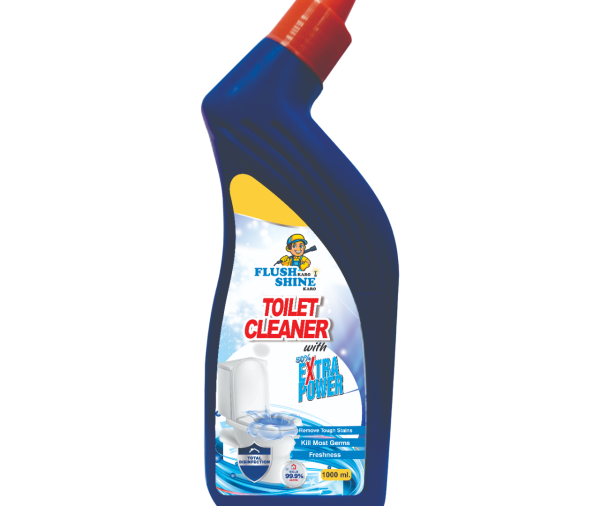
Flush Shine’s Toilet Cleaner comes in this 1000ml size, currently listed at ₹90 (down from an MRP of ₹149), with cash-on-delivery available at checkout — which matters more than it sounds for a category where people still like to see and smell a cleaning product before committing to a full-size bottle. For a two-bathroom home, a single 1000ml bottle typically stretches across both if you’re not over-pouring, which is the most common way people burn through cleaner faster than they need to.
How to Actually Use a Toilet Cleaner (Most People Skip Two of These Steps)
Pour-and-brush is not a technique. It’s what people do when they’re in a hurry, and it’s why the same stains keep coming back.
- Flush first, then let the water level drop slightly if your toilet allows it, or squeeze the cleaner directly under the rim where water doesn’t fully rinse. This is where biofilm builds fastest and where most people never actually clean.
- Apply along the rim in a continuous line, not just a splash in the bowl. Gravity pulls it down the sides on its own — you’re not adding extra work, you’re just aiming correctly.
- Wait. Actually wait. Most bottles say 5–10 minutes for a reason: that’s the contact time the active ingredient needs to break down mineral bonds or kill bacteria. Scrubbing immediately after pouring wastes most of the product’s effectiveness.
- Scrub with a stiff brush, focusing on the waterline ring and under the rim — the two spots where standing water and low airflow create the worst buildup.
- Flush and, if it’s a hard water area, repeat weekly rather than daily. Daily light cleaning with weekly deep treatment beats daily deep treatment, because it doesn’t over-strip the porcelain’s natural seal.
The step people skip most often is the wait time. It’s tempting to scrub right away, especially with a strong-smelling product that feels like it’s “already working” from the smell alone. Resist it. Contact time is doing more of the actual cleaning than the scrubbing is.
Mistakes That Quietly Ruin a Good Cleaner’s Performance
A few habits undercut even a well-formulated toilet cleaner, and I see all of them constantly:
- Mixing cleaners. Never combine a bleach-based cleaner with an acid-based one in the same session, even hours apart without a thorough flush between them. The chemical reaction isn’t just ineffective — it can release harmful fumes in an enclosed bathroom.
- Using it on other surfaces out of convenience. Toilet bowl formulas are built for porcelain, not tile grout, chrome fittings, or plastic seats. Repeated contact can dull chrome and degrade rubber seals over time.
- Storing the bottle somewhere humid with the cap loose. Bathroom humidity plus an open cap slowly dilutes and weakens concentrated formulas — you’re paying full price for a product that’s lost potency before you even use half the bottle.
- Assuming stronger smell means stronger cleaning. Fragrance intensity and active-ingredient strength are formulated independently. A heavily scented cleaner can be mild, and a near-odorless one can be aggressive.
Choosing Between Options: A Practical Framework
When you’re standing in front of several bottles — or several browser tabs — this is the order I’d actually check things in:
First, match it to your water type. If you’re in a hard water area (most of North India falls here), prioritize acid-based or acid-forward formulas. Soft water areas can lean toward bleach or enzyme formulas without worrying about scale buildup.
Second, check formula thickness against your problem. Thin, watery cleaners are fine for maintenance cleaning on a bowl that’s already in good shape. Thick gel formulas earn their price difference when you’re dealing with existing stains that need contact time to lift.
Third, factor in household size against pack size. A single person in a one-bathroom flat doesn’t need the same pack size as a family running two bathrooms through daily use. Buying too large a bottle for low usage just means the product sits open longer and slowly loses potency.
Fourth — and this gets skipped constantly — check whether COD or easy returns are available if you’re buying a cleaning product you haven’t used before. It’s a low-cost category, but nobody wants to commit blind to a full bottle of something that might not suit their bathroom.
Toilet Cleaner vs. General Bathroom Cleaner: Not Interchangeable
I still see people grab whatever multi-surface spray is closest to hand and use it on the toilet bowl because “it’s all bathroom cleaning anyway.” It isn’t, and the difference matters more than most product marketing admits.
General bathroom or surface cleaners are formulated for tile, glass, and countertop-adjacent fittings — surfaces that aren’t sitting in standing water and aren’t dealing with mineral scale below a waterline. They’re usually milder, lower in active-acid or active-chlorine content, and built to evaporate cleanly without residue on a visible, touched-often surface.
A toilet bowl formula is the opposite brief. It’s built to sit in water, survive dilution, and still have enough active ingredient left to break down scale or kill bacteria after several minutes of contact. That’s why a toilet cleaner poured onto a bathroom tile can feel unexpectedly harsh, and why a diluted glass cleaner does almost nothing when poured into a bowl.
The practical takeaway: keep the two separate, budget for both, and resist the “one bottle does everything” instinct. It usually means one job is being done adequately and the other poorly.
Handling and Storage — the Part Nobody Reads on the Label
A few storage habits protect both the product’s effectiveness and your household’s safety:
- Keep the cap tightly closed between uses. Beyond preventing spills, this slows the slow potency loss that happens when concentrated formulas are repeatedly exposed to bathroom humidity.
- Store upright, away from direct sunlight. UV exposure and heat both accelerate the breakdown of active cleaning agents over time, particularly in clear or lightly tinted bottles.
- Keep it out of reach of children and pets, and never transfer it into an unlabeled container. Toilet cleaners are concentrated enough that accidental ingestion or skin contact needs to be treated seriously — check the label for first-aid guidance specific to that formula.
- If you notice a change in color, thickness, or smell compared to when you bought it, that’s usually a sign the formula has started breaking down. It’s not necessarily unsafe, but it’s no longer working at full strength.
None of this is complicated, but it’s the difference between a bottle that performs consistently until it’s empty and one that quietly loses effectiveness by the halfway mark.
Frequently Asked Questions
How often should I use toilet cleaner?
For most households, a proper deep clean with contact time once or twice a week is enough, with a quick daily brush-and-flush in between. Hard water areas may need weekly acid treatment specifically for scale, separate from general cleaning.
Can toilet cleaner damage the toilet bowl?
Regular use of a standard formula won’t damage porcelain. Damage typically comes from leaving highly acidic or bleach-based products sitting for far longer than instructed, or from using them on non-porcelain fittings like chrome or rubber seals.
Is a thicker (gel) formula always better than a liquid one?
Not always — it depends on the problem. Gel formulas win on vertical cling time for tough, set-in stains. Thin liquid formulas work fine for maintenance cleaning on a bowl that isn’t heavily stained.
Does a stronger smell mean the cleaner is working better?
No. Fragrance strength and cleaning-agent strength are formulated separately, so smell alone isn’t a reliable indicator of how effective a product actually is.
How long does a 1000ml bottle typically last? At a typical 15–30ml per application, a 1000ml bottle generally covers 30–65 cleaning sessions, which works out to roughly two to four months for a single-toilet household under regular use.
Should I check formulation details before buying?
Yes — specific active ingredients, fragrance type, and concentration vary by product and are worth checking on the product label or listing before purchase, especially if anyone in the household has sensitivities to strong fragrances or chemical fumes.